The Institute of Historical Research at the School of Advanced Studies of the University of London hosts our seminar on Collecting & Display. The monthly seminars take place at the Institute, Senate House, Malet St, London WC1E 7HU. Seminars begin at 6.00 and last approximately one hour.
Please see the Conferences page for recent updates.
PLEASE NOTE THAT IF YOU HAVE NOT BEEN RECEIVING EMAILS FROM US YOU SHOULD CHECK THAT YOU HAVE GIVEN US YOUR UP TO DATE ADDRESS AND MAKE SURE THAT THE EMAILS ARE NOT GOING STRAIGHT TO SPAM. IF YOU ARE HAVING DIFFICULTIES, PLEASE CONTACT collectingdisplay@gmail.com
SPRING 2026
The Seminar for Collecting and Display invites you to its forthcoming seminars
IN PERSON OR ON ZOOM
Seminar for Collecting and Display invites you to its seminar
on Monday, 19th January, 2026, at 6pm GMT
Sujatha Chandrasekaran will speak on:
The Crimean Collections of Ignacy Terlecki
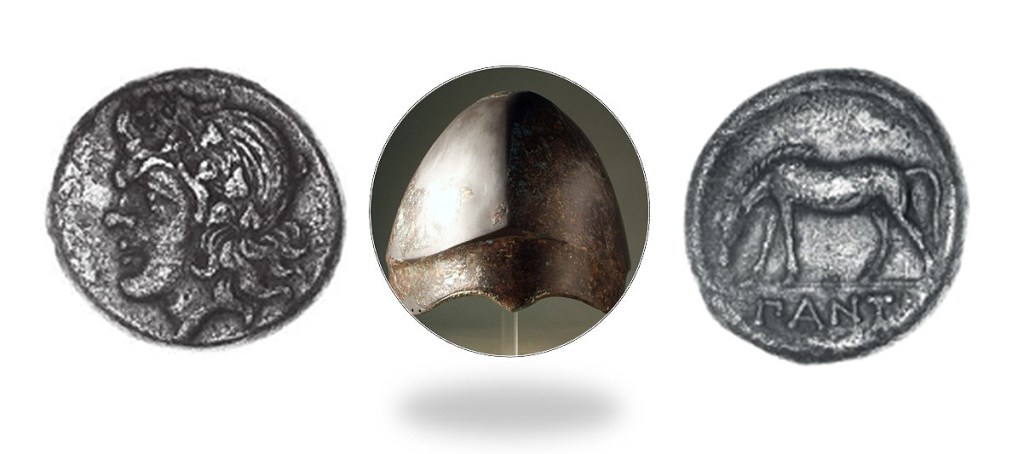
A final critical question will examine the problems and potential of modern provenance research for collections from Imperial Russia in Western European museums.One of the best-known collectors of antiquities in pre-revolutionary Russia was I. A. Terlecki, a Polish doctor stationed in Kerch at the turn of the 19th to 20th centuries. During his time in Kerch, he amassed a large collection of artefacts from the Crimea – mostly from Kerch and its environs. Terlecki collected mainly coins, but also numerous other archaeological artefacts. As a collector, he was an exception for his time, studiously documenting details about many of his acquisitions, and often including information about their find locations. Terlecki began selling objects from his collection from the beginning of the 20th century, offering them to both Russian and foreign museums and collectors, including in Berlin and Krakow. Following his death, his wife sold a further selection of her husband’s large collection in Kerch and in Poland, leading to its further dispersal, which continued into the 21st century.
This paper presents the collecting activities of Ignacy Terlecki, together with the history of the collection’s dispersal throughout Europe. I will use his own documentation to illustrate the sites and landscapes from which the objects originated, while highlighting the context of their sales to and by him. The discussion will not only address the scope and wealth of activity in ancient Crimea but expose the dominating presence of collections from the Northern Black Sea region now housed in leading European museums. A final critical question will examine the problems and potential of modern provenance research for collections from Imperial Russia in Western European museums.
Speaker Biography
Dr Sujatha Chandrasekaran is an archaeologist specializing in sites of the Caucasus and the Near East. Her 2012 dissertation (University of Oxford) examined the phenomenon of Greek-style armor in the Western Caucasus. In following, she was a research assistant and lecturer at the University of Gothenburg, Sweden, and at the International Hellenic University in Thessaloniki, Greece. She is currently a freelance associate with the Educational Department of the Staatliche Museen zu Berlin, where she works with the archaeological collections of the Museum Island. Sujatha also collaborates with excavation teams working in Cyprus, Turkey, Jordan, Sudan and Greece, and regularly shares her research findings in numerous publications in Russian, English and German.
JOINING INSTRUCTIONS
Our speaker will present in person so do join us if you can.
To attend in person: The seminar will take place in Senate House, Malet St London WC1E 7HU, Room 349. Please register with the Institute of Historical Research by Sunday evening that you will be attending in person.
To attend online: Please register with the Institute of Historical Research by Sunday evening and you will be sent the zoom link on registration and again on the day. If you do not receive the link on registration and you wish to attend, please contact collectingdisplay@gmail.com and we will make sure that you are on the list. Some emails are still going to spam and if you don’t get a reply, please email as an alternative adrianaturpin@gmail.com.Please note: you need to register by Sunday evening.
Seminar for Collecting and Display invites you to its seminar
on Zoom
on Monday, 16th February, 2026, at 6pm GMT
Paul Holden will speak on
The Collecting Habits of the Earls of Radnor (first creation, 1679-1758)

Lanhydrock, Photo Paul Holden
As collectors, the first creation Earls of Radnor (1679-1758) have been overshadowed by the second creation Radnors (cr.1765), the Pleydell-Bouverie family of Longford castle in Wiltshire. This talk will explore the collections and collecting habits of the first four Earls whose original ancestral seat was in Cornwall. Beyond the internationally important library at Lanhydrock near Bodmin, amassed by the 1st Earl, little survives of the collections they amassed. From their lavish homes on St James’s Square, Wimpole Hall in Cambridgeshire and Twickenham, the 2nd and 4th earls, in particular, were great collectors and patrons of the arts while the frivolous 3rd Earl went on a lavish, and extended, Grand Tour and between 1724 and 1741, the year of his death. What emerges from this paper are four differing men with a common interest in connoisseurship and collecting.
Paul Holden worked for twenty years with the National Trust before setting up as a freelance architectural historian and heritage professional. He is a Fellow of the Society of Antiquaries of London, a Visiting Research Fellow at Plymouth University, Chairman of the Truro Diocese Advisory Committee and the Church Uses Committee, Trustee of the Royal Cornwall Museum and President of the James M MacLaren Society and the Cornwall Family History Society. He has published and lectured extensively on a wide range of topics including architectural history, cartography, curatorship, heritage management and seventeenth- and eighteenth-century travellers’ first-hand descriptions of Cornwall and London. Paul is also the Editor of Heritage Now, the magazine of Historic Buildings & Places, and the Journal of Historic buildings & Places.
JOINING INSTRUCTIONS
This paper will be on Zoom only.
To attend online: Please register with the Institute of Historical Research by Sunday evening and you will be sent the zoom link on the day. If you do not receive the link and you wish to attend, please contact collectingdisplay@gmail.com. Some emails are still going to spam and if you don’t get a reply when you book, please email as an alternative adrianaturpin@gmail.com to get the link.
Please note: you need to register by Sunday evening.
Seminar for Collecting and Display invites you to its seminar
on Monday, 23rd March, 2026, at 6pm GMT
Kari Tuovinen will speak on:
Tools for Analysis of Art Collections and Collecting
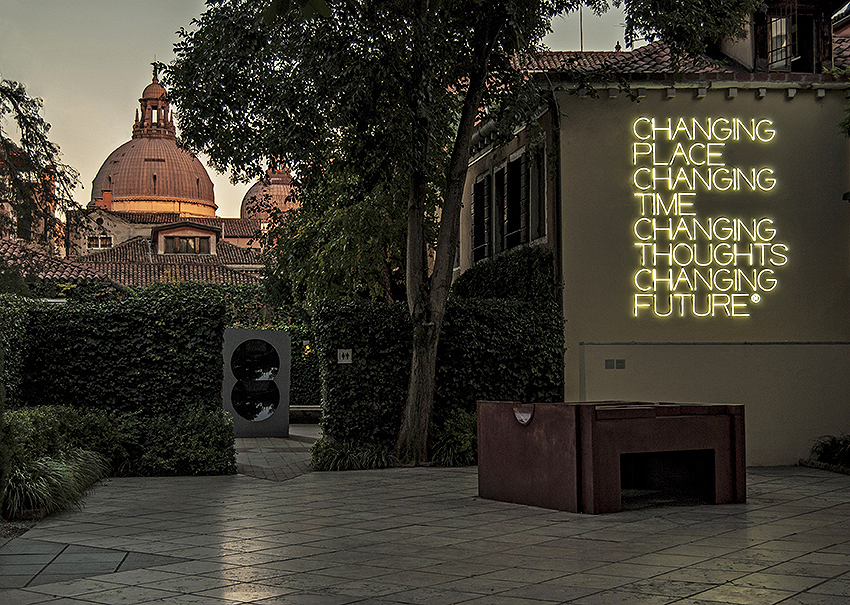
Maurizio Nannucci, Changing Place, on display at the Peggy Guggenheim Collection, Venice, in 2015 [Galleria Fumagalli/Wikimedia Commons]
Statements about art collections and collecting are often ambiguous. For example, what is meant with a “coherent collection” or a “bold collector”? Many properties of art collections and modes of collecting can be expressed in a systematic form with numeric indicators. The author has built a reference database of 70 collections, including the Gallup Art Foundation, Peggy Guggenheim and Vaticani Moderna collections. The database comprises reference values of 30 indicators that can be used for analysis of collection structural and process properties. The use will be demonstrated with three collecting process and collection structure case analyses.
Indicators on collection structure include, for example, the works’ time range, the number of artistic media, and price categories of the works. The structural profiles of the Greta Garbo and John Maynard Keynes collections will be compared with six indicators. Collecting process indicators comprise e.g. the number and type of purchase channels, budget, artist age distribution, as well as the lapse between work completion and purchase. The collecting process history of The Kouri Collection of Contemporary Art and the risk level of Professor Kouri’s collecting style will be investigated with a set of indicators. Indicators can also be used as a tool for testing statements about the nature of collections: the Critic Clement Greenberg stated that the private art collection of Erich Maria Remarque is coherent – this proposition will be tested with four indicator reference values.
The presentation will be concluded with a discussion on limitations and opportunities of the indicator tools. Also, a general framework for analysis of art collections will be proposed; the model elements are structure, process, and content.
Speaker biography Kari Tuovinen (M.S. Econ., Aalto University) is an independent scholar specializing in the study of art collections with a multidisciplinary and methodological perspective. He has published five peer-reviewed articles and presented at various domestic and international forums. Among the article topics are operationalisation of the concept of collection unity, identifying of collecting style profiles, and analysis of collection highlight work profiles. Kari’s current research interests include artwork disposal processes and deconstruction of collecting narratives.
JOINING INSTRUCTIONS
Our speaker will present in person so do join us if you can.
To attend in person: The seminar will take place in the Institute of Historical Research, Senate House, Malet St London WC1E 7HU, room Pollard 301. Please register with the Institute of Historical research by Sunday evening that you will be attending in person.
To attend online: Please register with the Institute of Historical Research by Sunday evening and you will be sent the zoom link on the day. If you do not receive the link and you wish to attend, please contact collectingdisplay@gmail.com. Some emails are still going to spam so if you don’t get a reply on the day, please email as an alternative adrianaturpin@gmail.com.
Please note: you need to register by Sunday evening.
 collectinganddisplay.org